




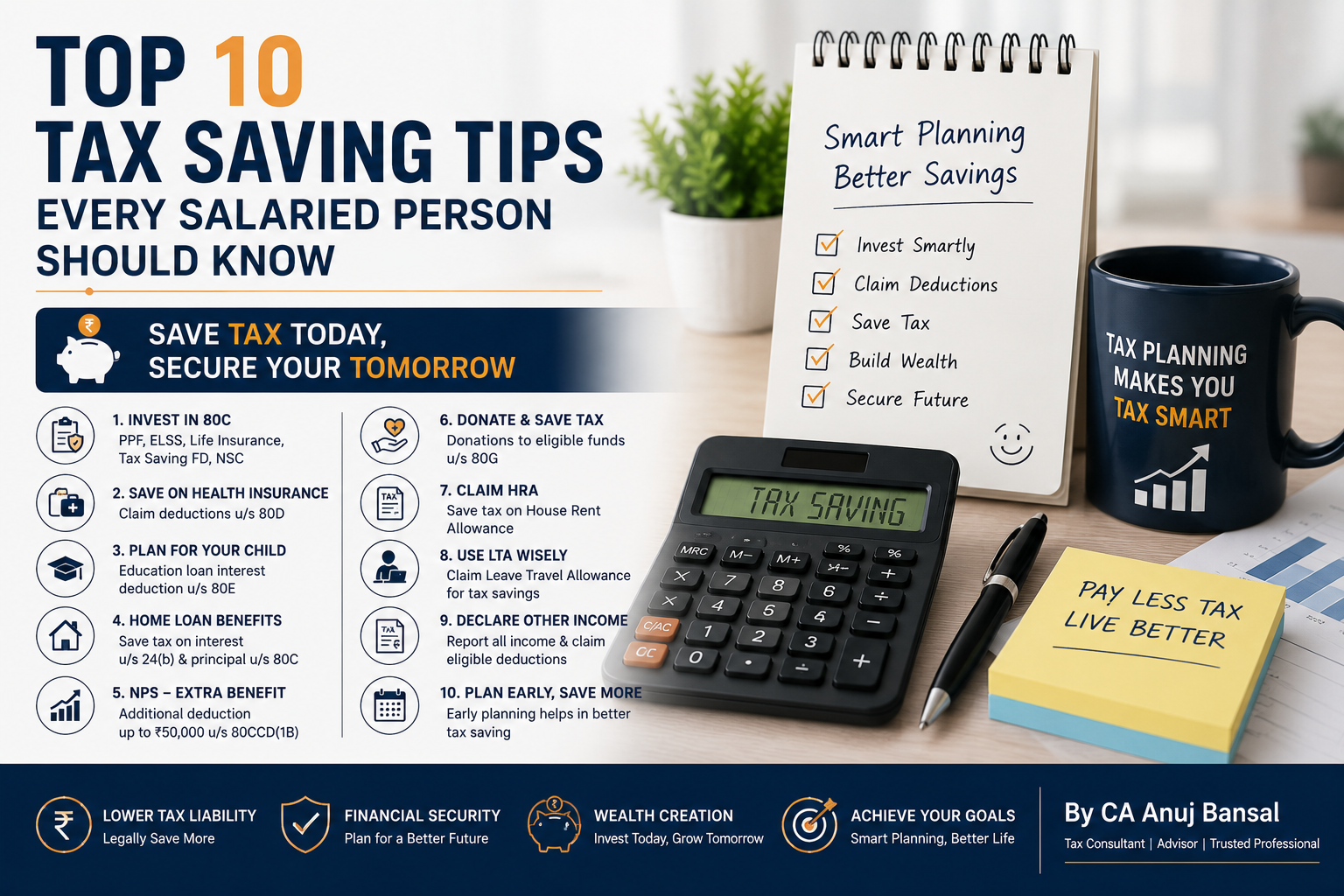
Top 10 Tax Saving Tips Every Salaried Person Should Know
By CA Anuj Bansal
Introduction
Every salaried employee wants to reduce their tax burden legally while maximizing savings. However, many people wait until the end of the financial year to think about tax planning. This often leads to rushed investment decisions and missed opportunities to save money.
Effective tax planning is not about avoiding taxes—it’s about making informed financial decisions that help you claim the deductions and exemptions available under the Income-tax Act. By planning throughout the year, you can lower your tax liability, build long-term wealth, and improve your financial security.
In this guide, we share ten practical tax-saving tips that every salaried person should know.
Why Tax Planning Is Important
Good tax planning offers several advantages:
- Reduces your tax liability legally.
- Helps you build disciplined savings habits.
- Encourages long-term investments.
- Improves financial security.
- Prevents last-minute investment decisions.
- Ensures timely Income Tax Return (ITR) filing.
Planning your taxes early gives you more flexibility to choose suitable financial products and avoid unnecessary stress at the end of the financial year.
- Understand Your Tax Regime
Before making any investment decisions, understand which tax regime is applicable to you and compare the available options, if eligible. The choice of tax regime can affect the deductions and benefits available under the law.
A proper comparison can help you make an informed decision based on your income and financial goals.
- Invest in Eligible Tax-Saving Instruments
The Income-tax Act provides deductions for certain eligible investments, subject to the applicable provisions and limits.
Examples may include:
- Public Provident Fund (PPF)
- Employees’ Provident Fund (EPF)
- Equity Linked Savings Scheme (ELSS)
- National Savings Certificate (NSC)
- Tax-saving Fixed Deposits
- Life Insurance Premiums (where eligible)
Choose investments that match both your tax objectives and long-term financial plans.
- Take Advantage of Health Insurance Benefits
Health insurance not only protects you financially during medical emergencies but may also provide tax benefits if eligible under current tax laws.
Health insurance for yourself, your spouse, children, and eligible family members can contribute to both financial security and tax planning.
- Plan Home Loan Benefits Carefully
If you have a home loan, you may be eligible for tax benefits on qualifying principal repayments and interest payments, subject to the applicable provisions of the Income-tax Act.
Maintaining proper loan documentation is important while claiming these benefits.
- Keep Proper Investment Records
Maintain organized records of:
- Investment proofs
- Insurance premium receipts
- Home loan statements
- Donation receipts
- Education loan documents
- Medical insurance receipts
Proper documentation simplifies both employer declarations and ITR filing.
- Report Every Source of Income
Many taxpayers unintentionally forget to disclose additional income such as:
- Savings account interest
- Fixed Deposit interest
- Rental income
- Dividend income
- Freelancing income
- Capital gains
Reporting all income accurately helps avoid notices, penalties, and future complications.
- File Your Income Tax Return on Time
Even if your tax liability is minimal, timely ITR filing offers several advantages.
Benefits include:
- Avoiding late filing penalties
- Easier loan approvals
- Faster tax refunds (where applicable)
- Stronger financial records
- Better compliance with tax laws
Timely filing demonstrates responsible financial management.
- Review Your Salary Structure
Certain salary components may have different tax implications under applicable tax rules.
Reviewing your salary structure with a qualified tax professional can help ensure that your compensation is structured efficiently and in accordance with the law.
- Start Tax Planning Early
Waiting until the last month of the financial year often leads to poor financial decisions.
Early tax planning allows you to:
- Spread investments throughout the year.
- Improve cash flow management.
- Select better investment options.
- Avoid unnecessary financial pressure.
A planned approach generally produces better financial outcomes.
- Seek Professional Tax Advice
Income tax laws change periodically. Professional guidance helps you understand the latest rules and make informed decisions based on your financial situation.
A Chartered Accountant can assist with:
- Tax planning
- Income Tax Return filing
- Deduction review
- Investment-related tax implications
- Business income reporting
- Tax notices and compliance
Expert advice can reduce errors and improve overall tax efficiency.
Common Tax Planning Mistakes
Avoid these common mistakes:
- Waiting until the last minute to invest.
- Ignoring tax law updates.
- Failing to keep investment proofs.
- Reporting incomplete income.
- Filing the wrong ITR form.
- Missing return filing deadlines.
- Depending solely on assumptions without professional advice.
Good planning and accurate documentation can prevent these issues.
Why Choose CA Anuj Bansal?
At CA Anuj Bansal, we provide personalized tax planning and compliance services for salaried individuals, professionals, and business owners.
Our services include:
- Income Tax Return Filing
- Tax Planning
- Tax Saving Consultation
- GST Services
- Business Tax Advisory
- Accounting & Bookkeeping
- Financial Compliance
- Tax Notice Assistance
Our objective is to help clients remain compliant while making informed financial decisions.
Final Thoughts
Tax planning should be an ongoing financial habit rather than a year-end activity. By understanding your tax obligations, maintaining proper records, and making timely financial decisions, you can legally optimize your tax position and strengthen your financial future.
If you need expert guidance for tax planning or Income Tax Return filing, CA Anuj Bansal is committed to providing professional, transparent, and reliable tax advisory services.