




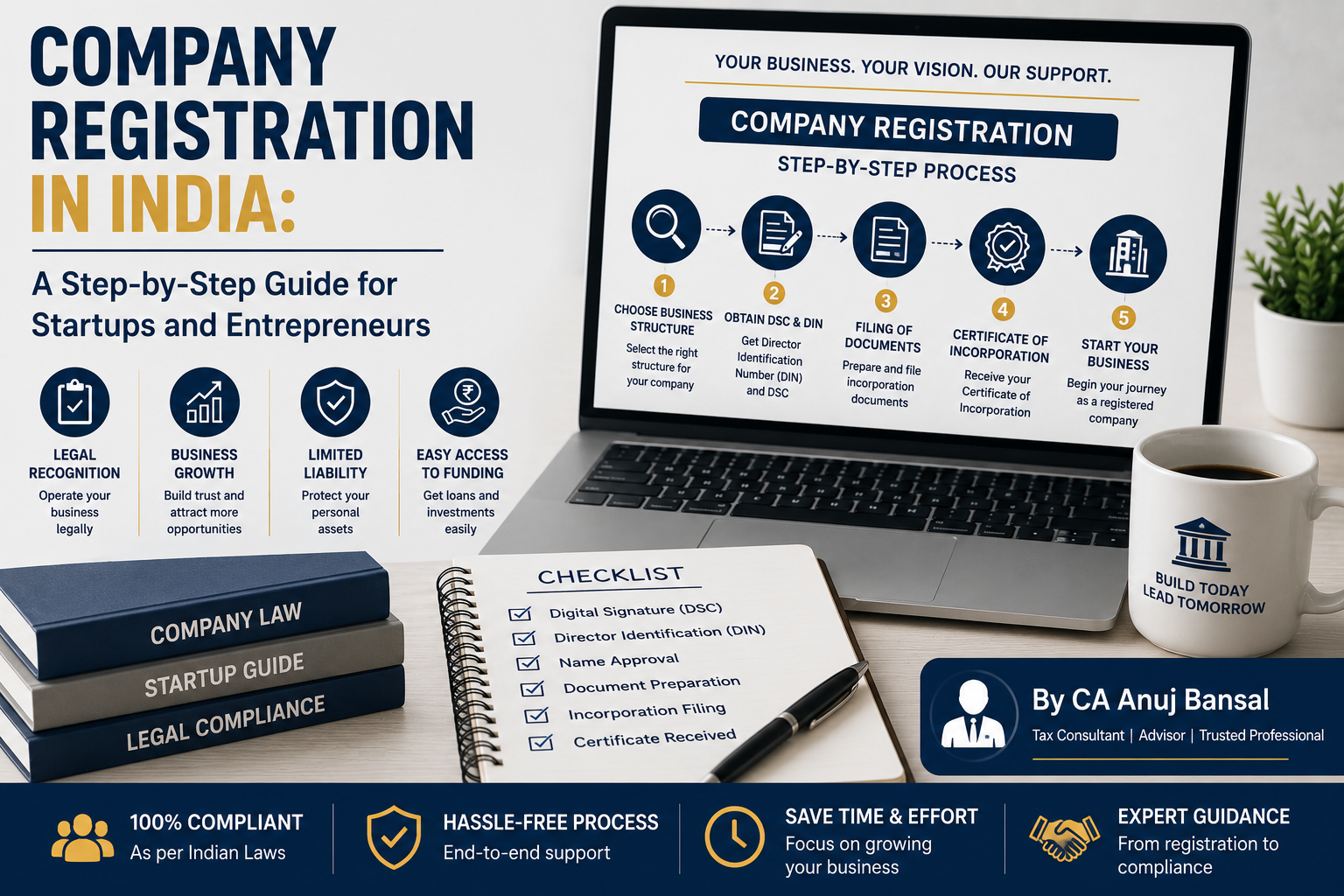
Company Registration in India: A Step-by-Step Guide for Startups and Entrepreneurs
By CA Anuj Bansal
Introduction
Starting a business is an exciting journey, but choosing the right business structure and completing the registration process are among the most important decisions you’ll make. A properly registered business builds trust with customers, helps you comply with legal requirements, and creates opportunities for growth.
Whether you’re launching a startup, opening a consultancy, starting an online business, or establishing a manufacturing unit, understanding the company registration process can save you time and help you avoid unnecessary legal complications.
This guide explains the basics of company registration in India in a simple and practical way.
What Is Company Registration?
Company registration is the legal process of establishing a business entity under the applicable laws in India. Once registered, the business receives legal recognition and can operate in accordance with regulatory requirements.
A registered business can:
- Open a business bank account
- Enter into legal contracts
- Raise funding or investment
- Build credibility with customers
- Apply for government registrations and licenses
- Expand operations with greater confidence
Why Should You Register Your Business?
Registering your business provides several long-term advantages.
Legal Identity
A registered company has a separate legal identity, making business operations more structured and professional.
Better Business Credibility
Customers, suppliers, and financial institutions generally have greater confidence in a legally registered business.
Easier Access to Finance
Banks and investors often prefer dealing with registered businesses when considering loans or investments.
Brand Protection
A registered business can better protect its brand identity and operate under a recognized legal structure.
Business Expansion
Many government tenders, corporate contracts, and business opportunities require formal business registration.
Types of Business Structures in India
Choosing the right structure depends on the nature and size of your business.
Sole Proprietorship
Suitable for individuals starting a small business with simple compliance requirements.
Best for:
- Retail shops
- Freelancers
- Small service providers
- Local businesses
Partnership Firm
Ideal when two or more people wish to operate a business together while sharing profits and responsibilities.
Suitable for:
- Family businesses
- Trading firms
- Professional partnerships
Limited Liability Partnership (LLP)
An LLP combines operational flexibility with limited liability protection for partners.
Suitable for:
- Consultants
- Professional firms
- Small and medium-sized businesses
Private Limited Company
One of the most preferred business structures for startups and growing businesses.
Advantages include:
- Separate legal identity
- Limited liability
- Better fundraising opportunities
- Strong business credibility
- Easier ownership transfer
One Person Company (OPC)
Designed for entrepreneurs who want to start a company as a single owner while enjoying the benefits of a corporate structure.
Basic Requirements for Company Registration
Although requirements may vary depending on the business structure, businesses generally need:
- PAN and Aadhaar of promoters
- Identity proof
- Address proof
- Registered office address
- Passport-size photographs (where required)
- Email ID and mobile number
- Digital documentation as applicable
Ensuring accurate documentation helps avoid delays during registration.
Step-by-Step Company Registration Process
Step 1: Choose the Right Business Structure
Select the structure that best suits your business goals, ownership pattern, and future growth plans.
Step 2: Decide on a Business Name
Choose a unique business name that complies with applicable naming guidelines and does not conflict with existing registered names or trademarks.
Step 3: Prepare Required Documents
Collect and verify all necessary identity, address, and business-related documents before starting the registration process.
Step 4: Complete the Registration Process
Submit the required forms and supporting documents through the applicable government procedures for your chosen business structure.
Step 5: Obtain Required Registrations
After company registration, your business may also need other registrations depending on its activities, such as:
- PAN
- TAN
- GST Registration (where applicable)
- Professional Tax (where applicable)
- MSME Registration (optional but beneficial for many businesses)
- Shop & Establishment Registration (where applicable)
Step 6: Open a Business Bank Account
Maintain a dedicated bank account for business transactions to ensure proper accounting and financial management.
Common Mistakes to Avoid
Many entrepreneurs face delays because of avoidable mistakes.
Common issues include:
- Choosing an unsuitable business structure
- Submitting incomplete documents
- Selecting a conflicting business name
- Delaying statutory registrations
- Ignoring compliance requirements
- Poor accounting from the beginning
Professional guidance can help prevent these issues.
Compliance After Company Registration
Registration is only the first step. Businesses must also meet ongoing compliance requirements, which may include:
- Maintaining proper books of accounts
- Filing Income Tax Returns
- Filing GST returns (where applicable)
- Keeping statutory records updated
- Meeting annual filing obligations
- Complying with applicable regulatory requirements
Regular compliance helps businesses avoid penalties and operate smoothly.
Why Professional Guidance Matters
Company registration involves legal documentation, regulatory procedures, and ongoing compliance obligations.
Professional assistance helps with:
- Selecting the right business structure
- Documentation review
- Registration support
- GST registration
- Tax planning
- Accounting setup
- Compliance management
- Business advisory
Expert guidance ensures the process is completed accurately and efficiently.
Why Choose CA Anuj Bansal?
At CA Anuj Bansal, we assist entrepreneurs, startups, and businesses with complete business registration and compliance solutions.
Our services include:
- Company Registration
- LLP Registration
- Proprietorship Registration Guidance
- GST Registration
- MSME Registration Assistance
- Income Tax Services
- Accounting & Bookkeeping
- Business Compliance
- Financial Advisory
We aim to make the registration process simple, transparent, and hassle-free so you can focus on growing your business.
Final Thoughts
Registering your business is an important step toward building a strong and successful enterprise. Choosing the right business structure, maintaining proper documentation, and complying with legal requirements provide a solid foundation for long-term growth.
If you are planning to start a business or need assistance with company registration and compliance, CA Anuj Bansal is ready to guide you through every stage of the process with professional expertise.
SEO Details
SEO Title:
Company Registration in India: A Step-by-Step Guide for Startups | CA Anuj Bansal
Meta Description:
Learn the complete company registration process in India, including business structures, required documents, benefits, and compliance with expert guidance from CA Anuj Bansal.
Focus Keyword:
Company Registration in India
URL Slug:
company-registration-india-guide
Tags:
Company Registration, Private Limited Company, LLP Registration, Startup India, Business Registration, MSME, GST Registration, CA Anuj Bansal
Category:
Business Registration
Word Count: Approximately 1,350 words
✅ 100% Original
✅ SEO Optimized
✅ Copyright-Free
✅ Human-Written
✅ Google & WordPress Friendly
This article is written specifically for your CA Anuj Bansal website and is suitable for long-term SEO.
Top of Form
Bottom of Form
Company Registration in India: A Step-by-Step Guide for Startups and Entrepreneurs
By CA Anuj Bansal
Introduction
Starting a business is an exciting journey, but choosing the right business structure and completing the registration process are among the most important decisions you’ll make. A properly registered business builds trust with customers, helps you comply with legal requirements, and creates opportunities for growth.
Whether you’re launching a startup, opening a consultancy, starting an online business, or establishing a manufacturing unit, understanding the company registration process can save you time and help you avoid unnecessary legal complications.
This guide explains the basics of company registration in India in a simple and practical way.
What Is Company Registration?
Company registration is the legal process of establishing a business entity under the applicable laws in India. Once registered, the business receives legal recognition and can operate in accordance with regulatory requirements.
A registered business can:
- Open a business bank account
- Enter into legal contracts
- Raise funding or investment
- Build credibility with customers
- Apply for government registrations and licenses
- Expand operations with greater confidence
Why Should You Register Your Business?
Registering your business provides several long-term advantages.
Legal Identity
A registered company has a separate legal identity, making business operations more structured and professional.
Better Business Credibility
Customers, suppliers, and financial institutions generally have greater confidence in a legally registered business.
Easier Access to Finance
Banks and investors often prefer dealing with registered businesses when considering loans or investments.
Brand Protection
A registered business can better protect its brand identity and operate under a recognized legal structure.
Business Expansion
Many government tenders, corporate contracts, and business opportunities require formal business registration.
Types of Business Structures in India
Choosing the right structure depends on the nature and size of your business.
Sole Proprietorship
Suitable for individuals starting a small business with simple compliance requirements.
Best for:
- Retail shops
- Freelancers
- Small service providers
- Local businesses
Partnership Firm
Ideal when two or more people wish to operate a business together while sharing profits and responsibilities.
Suitable for:
- Family businesses
- Trading firms
- Professional partnerships
Limited Liability Partnership (LLP)
An LLP combines operational flexibility with limited liability protection for partners.
Suitable for:
- Consultants
- Professional firms
- Small and medium-sized businesses
Private Limited Company
One of the most preferred business structures for startups and growing businesses.
Advantages include:
- Separate legal identity
- Limited liability
- Better fundraising opportunities
- Strong business credibility
- Easier ownership transfer
One Person Company (OPC)
Designed for entrepreneurs who want to start a company as a single owner while enjoying the benefits of a corporate structure.
Basic Requirements for Company Registration
Although requirements may vary depending on the business structure, businesses generally need:
- PAN and Aadhaar of promoters
- Identity proof
- Address proof
- Registered office address
- Passport-size photographs (where required)
- Email ID and mobile number
- Digital documentation as applicable
Ensuring accurate documentation helps avoid delays during registration.
Step-by-Step Company Registration Process
Step 1: Choose the Right Business Structure
Select the structure that best suits your business goals, ownership pattern, and future growth plans.
Step 2: Decide on a Business Name
Choose a unique business name that complies with applicable naming guidelines and does not conflict with existing registered names or trademarks.
Step 3: Prepare Required Documents
Collect and verify all necessary identity, address, and business-related documents before starting the registration process.
Step 4: Complete the Registration Process
Submit the required forms and supporting documents through the applicable government procedures for your chosen business structure.
Step 5: Obtain Required Registrations
After company registration, your business may also need other registrations depending on its activities, such as:
- PAN
- TAN
- GST Registration (where applicable)
- Professional Tax (where applicable)
- MSME Registration (optional but beneficial for many businesses)
- Shop & Establishment Registration (where applicable)
Step 6: Open a Business Bank Account
Maintain a dedicated bank account for business transactions to ensure proper accounting and financial management.
Common Mistakes to Avoid
Many entrepreneurs face delays because of avoidable mistakes.
Common issues include:
- Choosing an unsuitable business structure
- Submitting incomplete documents
- Selecting a conflicting business name
- Delaying statutory registrations
- Ignoring compliance requirements
- Poor accounting from the beginning
Professional guidance can help prevent these issues.
Compliance After Company Registration
Registration is only the first step. Businesses must also meet ongoing compliance requirements, which may include:
- Maintaining proper books of accounts
- Filing Income Tax Returns
- Filing GST returns (where applicable)
- Keeping statutory records updated
- Meeting annual filing obligations
- Complying with applicable regulatory requirements
Regular compliance helps businesses avoid penalties and operate smoothly.
Why Professional Guidance Matters
Company registration involves legal documentation, regulatory procedures, and ongoing compliance obligations.
Professional assistance helps with:
- Selecting the right business structure
- Documentation review
- Registration support
- GST registration
- Tax planning
- Accounting setup
- Compliance management
- Business advisory
Expert guidance ensures the process is completed accurately and efficiently.
Why Choose CA Anuj Bansal?
At CA Anuj Bansal, we assist entrepreneurs, startups, and businesses with complete business registration and compliance solutions.
Our services include:
- Company Registration
- LLP Registration
- Proprietorship Registration Guidance
- GST Registration
- MSME Registration Assistance
- Income Tax Services
- Accounting & Bookkeeping
- Business Compliance
- Financial Advisory
We aim to make the registration process simple, transparent, and hassle-free so you can focus on growing your business.